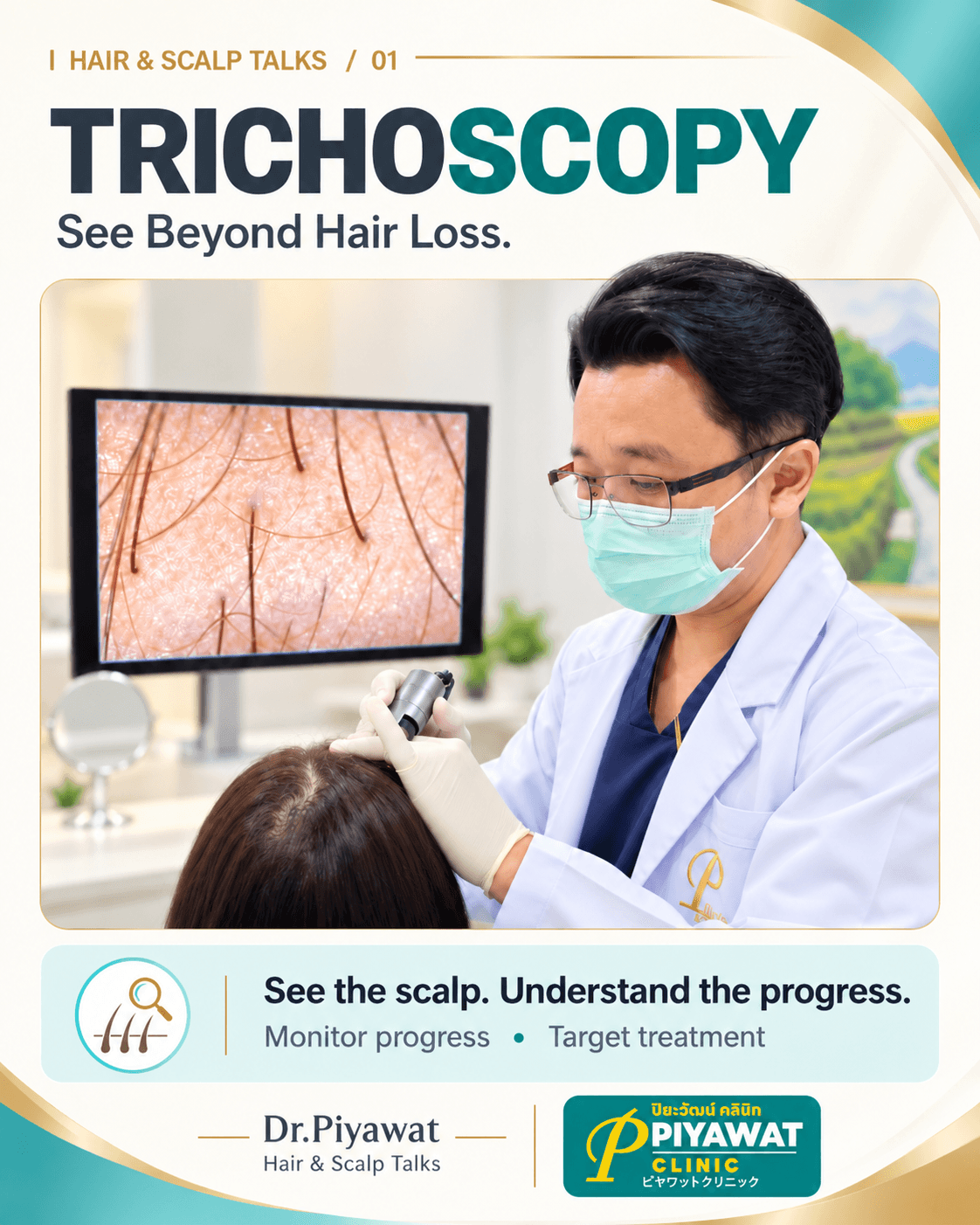


Why Regular Scalp Examinations Matter in Hair Loss Diagnosis and Treatment Monitoring
Dr.Piyawat | Hair & Scalp Talks — EP01
Hair loss is not always as obvious as finding excessive hair on your pillow or in the shower. In pattern hair loss (androgenetic alopecia), changes can develop gradually within the follicles before thinning becomes noticeable. Individual strands may grow progressively finer, while some scalp areas lose density faster than others.
How can we detect these changes early, and how can we tell whether hair loss treatment is working? One valuable clinical tool is trichoscopy.
What Is Trichoscopy?
Trichoscopy is a non-invasive examination of the hair and scalp using a specialized magnifying device. It enables dermatologists to examine hair shafts, follicular openings and scalp features in greater detail than is possible with the naked eye.
Trichoscopy helps physicians recognize patterns associated with different forms of hair loss. Importantly, it can also support the monitoring of treatment response when findings are compared under consistent conditions over time.
What Can Trichoscopy Reveal?
1. Hair Miniaturization
Hair miniaturization is a characteristic feature of androgenetic alopecia. During this process, formerly thick terminal hairs may become finer and shorter. Under magnification, hairs of noticeably different diameters may be seen in the same area. This hair shaft diameter diversity provides a useful clue to pattern hair loss, particularly when interpreted together with the clinical examination.
2. Hair Density and Follicular Units
Trichoscopy helps evaluate how hairs are distributed across the scalp. A follicular unit can contain one or several hairs. A higher proportion of single-hair follicular units may be seen in areas affected by thinning, although the finding alone does not establish a diagnosis. Comparing scalp regions can reveal where hair density or caliber is most affected.
3. Scalp Inflammation and Follicular Changes
Trichoscopy may show redness around follicles, scaling, changes in follicular openings or other features suggesting an inflammatory scalp disorder. These signs matter because not all hair loss is androgenetic alopecia. Some inflammatory and scarring conditions need prompt assessment and a different management approach.
4. Early Signs of Regrowth
During treatment, short emerging hairs and changes in shaft thickness may be documented. A short hair by itself is not proof of successful treatment, however. The meaning depends on the diagnosis and on comparisons with previous examinations.
Why Examine the Scalp at Every Follow-Up Visit?
Not every area of the scalp responds to treatment in the same way. A patient may improve at the vertex while the frontal or temporal regions continue to show miniaturized hairs. These differences can be difficult to recognize through visual inspection alone.
At Piyawat Clinic, trichoscopy is incorporated into every hair treatment follow-up visit. By examining and documenting corresponding scalp regions over time, the physician can look for changes in hair shaft thickness, distribution, signs of regrowth and inflammation.
Compare the Same Areas Over Time
Serial examinations become more meaningful when the same scalp locations are assessed using comparable imaging conditions. Changes may be subtle and often take months to become clear. Trichoscopy contributes to long-term monitoring rather than providing an instant verdict after a single visit.
Identify Areas That Still Need Attention
Some regions may remain thin even while other areas improve. Repeated trichoscopy can help identify where the physician should reassess the diagnosis, adherence to treatment, persistent inflammation or the need for additional care.
Guide More Targeted Treatment
Based on the diagnosis and overall clinical assessment, the physician may recommend a more focused approach to specific scalp regions, including adjusting where topical medication is applied, optimizing the existing treatment plan or addressing an underlying scalp condition. These decisions are individualized; trichoscopy findings are one component of the assessment.
How We Use Trichoscopy at Piyawat Clinic
Our physicians may examine the frontal scalp, frontal hairline, mid-scalp, vertex and temporal regions according to the patient’s hair loss pattern. Repeated trichoscopic documentation supports our approach: understand the problem, monitor progress and adjust treatment when clinically appropriate.
Trichoscopy does not replace a medical history, physical examination or laboratory tests and other investigations when they are necessary.
Frequently Asked Questions
Is trichoscopy painful?
No. It is a non-invasive examination performed with a magnifying device placed close to, or gently in contact with, the scalp.
Can trichoscopy detect early hair thinning?
It can reveal miniaturized hairs and increased hair diameter variability before thinning is readily visible, depending on the underlying condition.
Why repeat trichoscopy during treatment?
Repeating the examination allows clinicians to compare the same scalp regions over time and identify areas that may need closer attention or an adjustment in the treatment plan.
Can trichoscopy confirm whether treatment is working?
It can provide useful evidence of change when examinations are standardized, but results must be interpreted alongside clinical findings. Meaningful changes in hair growth usually take time.
A More Personalized Approach to Hair Loss Care
Hair loss management is more than assessing whether hair looks fuller. It involves recognizing the cause, monitoring different scalp regions and selecting treatment according to each patient’s needs.
Examine. Monitor. Adjust. Personalize.
Hair & Scalp Consultation at Piyawat Clinic
If you are experiencing excessive shedding, progressive thinning, a widening hair part or changes in your hairline, a detailed assessment may help clarify the problem and guide next steps.
Hair & Scalp Consultation: THB 2,000 (includes physician consultation and trichoscopic examination).
Piyawat Clinic — 26/2 Soi Thonglor 23, Sukhumvit 55, Bangkok 10110, Thailand.
Appointments and information: https://www.piyawatclinic.com/en/services
Author: Dr. Piyawat Poomsuwan, Medical Director, Piyawat Clinic
Medical References
Kuczara A, Waśkiel-Burnat A, Rakowska A, et al. Trichoscopy of Androgenetic Alopecia: A Systematic Review. J Clin Med. 2024;13(7):1962. https://doi.org/10.3390/jcm13071962
İritaş SY, Özcan D. The Value of Trichoscopy in the Follow-up of Treatment Response in Patients With Androgenetic Alopecia. Dermatol Pract Concept. 2024;14(1):e2024001. https://doi.org/10.5826/dpc.1401a1
Bolzon A, et al. The Role of Dermoscopy in the Management of Hair and Scalp Disorders: From Diagnosis to Therapeutic Monitoring. Dermatol Ther. 2026. https://doi.org/10.1155/dth/5514819
DermNet. Trichoscopy: A Complete Overview. https://dermnetnz.org/topics/trichoscopy