
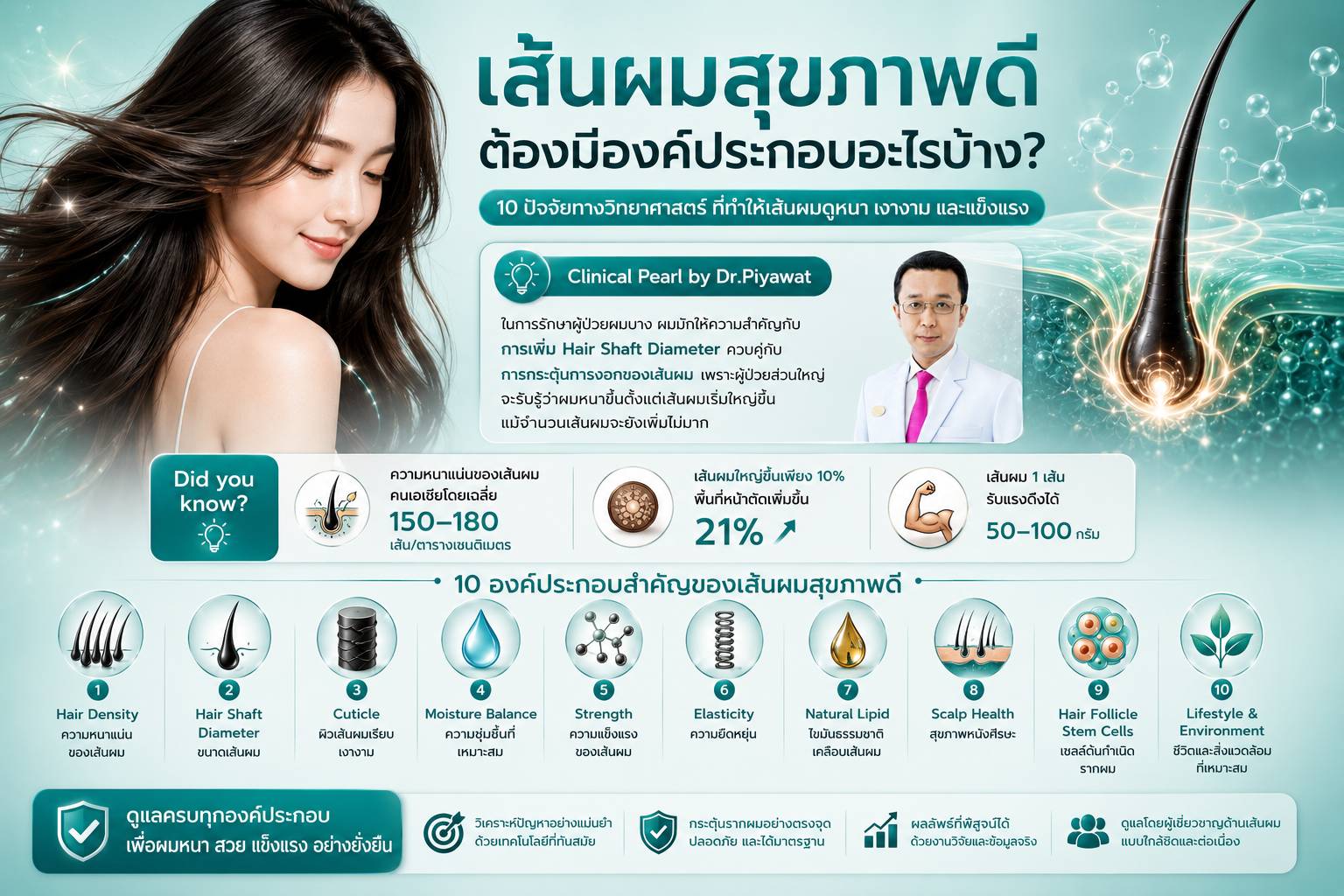
10 Scientific Factors That Make Hair Look Thicker, Shinier, and Stronger
Article by Dr. Piyawat Poomsuwan
👨⚕️ Clinical Pearl by Dr. Piyawat
When treating patients with hair thinning, I often focus on increasing Hair Shaft Diameter alongside stimulating new hair growth. This is because most patients perceive their hair as becoming thicker and fuller as soon as individual hair fibers become larger, even before a significant increase in hair count occurs.
Key Takeaways
- Beautiful hair is not determined by hair count alone.
- A 10–20% increase in hair diameter can significantly improve the appearance of hair volume.
- A healthy scalp is the foundation for producing high-quality hair.
- Hair Follicle Stem Cells are the source of new hair growth and represent one of the most important targets in modern hair restoration therapies.
Many people believe that “more hair means better hair.”
In reality, healthy and attractive hair depends on multiple factors, including hair density, hair thickness, hair structure, and scalp health.
Modern hair biology has shown that healthy-looking hair requires the coordinated function of multiple systems, ranging from stem cells within the hair follicle to the cuticle layer on the hair surface.
1. Hair Density
Hair density refers to the number of hair fibers per unit area of the scalp.
Studies have reported that:
- Asians typically have an average hair density of approximately 150–180 hairs/cm²
- Europeans often have approximately 180–220 hairs/cm²
- When density falls below 80–100 hairs/cm², the scalp becomes increasingly visible, particularly along the hair part line
This explains why many individuals perceive hair thinning even when total hair count has decreased by only 30–40%.
💡 Did You Know?
Humans typically have between 80,000 and 150,000 hair follicles on the scalp.
Blonde individuals tend to have the highest hair counts, whereas people with red hair generally have fewer hairs but larger hair shaft diameters.
Reference: Tobin DJ. Biology of the Hair Follicle.
2. Hair Shaft Diameter
Hair shaft diameter is one of the most important determinants of hair appearance.
Hair fibers are generally categorized as:
| Hair Type | Diameter |
| Fine Hair | < 50 μm |
| Medium Hair | 50–80 μm |
| Thick Hair | > 80 μm |
In patients with Androgenetic Alopecia, hair fibers progressively shrink from approximately 80 μm to as little as 30–40 μm before the follicle eventually miniaturizes.
This process is known as Hair Miniaturization.
💡 Did You Know?
The average hair diameter in Asians ranges from approximately 70–100 μm.
In contrast, patients with androgenetic alopecia often exhibit hair diameters as small as 30–40 μm, a hallmark of follicular miniaturization.
3. Why Does a 10% Increase in Hair Diameter Make Hair Look Much Thicker?
One of the most overlooked facts in hair science is that hair volume is closely related to the cross-sectional area of each hair fiber.
The cross-sectional area is calculated using:
Therefore:
- A 10% increase in hair diameter results in approximately a 21% increase in cross-sectional area
- A 20% increase in diameter produces nearly a 44% increase in cross-sectional area
This explains why treatments that slightly enlarge hair fibers can dramatically improve the perception of hair fullness, even without a major increase in hair count.
4. Hair Cuticle: The Secret Behind Shiny Hair
The cuticle is the outermost layer of the hair shaft and consists of approximately 6–10 overlapping layers of keratinized cells.
When the cuticle is intact and well aligned, it:
- Reflects light efficiently
- Reduces water loss
- Minimizes friction
- Protects the inner hair structure from environmental damage
Conversely, damaged cuticles can lead to dullness, frizz, dryness, and split ends.
This is why hair shine is often considered a visible indicator of hair quality.
5. Hair Moisture
Healthy hair typically contains approximately 10–15% water by weight.
Insufficient moisture may result in:
- Dryness
- Brittleness
- Increased breakage
However, excessive moisture can also weaken hair structure and make styling more difficult.
Maintaining moisture balance is therefore more important than simply increasing hydration.
What Makes Healthy Hair?
10 Scientific Factors That Make Hair Look Thicker, Shinier, and Stronger
Article by Dr. Piyawat Poomsuwan
👨⚕️ Clinical Pearl by Dr. Piyawat
When treating patients with hair thinning, I often focus on increasing Hair Shaft Diameter alongside stimulating new hair growth. Most patients perceive their hair as becoming thicker and fuller as soon as individual hair fibers become larger, even before a significant increase in hair count occurs.
6. Hair Strength
A single healthy hair fiber can withstand approximately 50–100 grams of tensile force before breaking.
Hair strength is primarily determined by:
- Keratin proteins within the cortex
- Disulfide bonds that stabilize the hair structure
- Overall hair shaft integrity
Chemical treatments such as bleaching, perming, and straightening, as well as frequent heat exposure, can damage these bonds and weaken the hair shaft.
As a result, hair becomes:
- More fragile
- More prone to breakage
- Less resistant to mechanical stress
Strong hair is therefore not simply a matter of thickness, but also of structural integrity.
7. Hair Elasticity
Hair elasticity refers to the ability of hair fibers to stretch and return to their original length without breaking.
Healthy hair can typically stretch:
- 10–15% when dry
- 20–30% when wet
before returning to its normal length.
Good elasticity indicates that the internal keratin structure remains intact and healthy.
Reduced elasticity often signals:
- Protein damage
- Excessive chemical processing
- Heat-related injury
- Structural deterioration of the cortex
Hair with poor elasticity tends to snap rather than stretch.
8. Scalp Health
The scalp serves as the biological environment in which hair follicles live and function.
A healthy scalp supports optimal hair growth by providing:
- Proper blood circulation
- Balanced sebum production
- A healthy microbiome
- Minimal inflammation
Chronic scalp inflammation, excessive oiliness, dandruff, or microbial imbalance may impair follicular function and lead to:
- Smaller hair fibers
- Increased shedding
- Reduced hair growth quality
Healthy hair begins with a healthy scalp.
9. Hair Follicle Stem Cells: The Origin of New Hair Growth
Within the bulge region of the hair follicle reside specialized stem cells known as Hair Follicle Stem Cells (HFSCs).
These cells are responsible for generating new hair throughout life and play a central role in hair cycling and regeneration.
Their activity is regulated by multiple biological signaling pathways, including:
- Wnt/β-catenin
- SCF/c-Kit
- VEGF
- IGF-1
- PI3K/AKT
- ERK
Modern hair regeneration research increasingly focuses on activating these pathways to produce:
- Larger hair follicles
- Thicker hair shafts
- Longer anagen (growth) phases
- Improved hair quality
Because these stem cells are the source of all newly generated hair, preserving their function is essential for long-term hair health.
10. Lifestyle and Environment
Daily lifestyle habits significantly influence hair growth and hair quality.
Important factors include:
Nutrition
Hair follicles require adequate supplies of:
- Protein
- Iron
- Zinc
- Vitamin D
- B vitamins
- Essential fatty acids
Nutritional deficiencies can impair normal hair production.
Sleep
Hair follicle regeneration and cellular repair occur continuously and are influenced by sleep quality.
Chronic sleep deprivation has been associated with increased hair shedding and impaired follicular function.
Stress
Psychological stress can alter hair cycling and contribute to conditions such as:
- Telogen Effluvium
- Increased hair shedding
- Trichodynia
Environmental Factors
Pollution, ultraviolet radiation, smoking, and harsh chemical exposure may accelerate hair aging and damage both the scalp and hair shaft.
Summary Table
| Factor | Contribution to Hair Beauty |
| Hair Density | Creates a fuller appearance |
| Hair Shaft Diameter | Creates thicker-looking hair |
| Hair Cuticle | Produces shine and smoothness |
| Hair Moisture | Maintains softness and flexibility |
| Hair Strength | Reduces breakage |
| Hair Elasticity | Prevents brittleness |
| Scalp Health | Supports healthy follicle function |
| Hair Follicle Stem Cells | Generate new high-quality hair |
| Lifestyle & Environment | Influence long-term hair quality |
Conclusion
If we had to identify the three most important factors influencing the appearance of hair, they would be:
1. Hair Density
The number of hair fibers present on the scalp.
2. Hair Shaft Diameter
The thickness of individual hair fibers.
3. Hair Cuticle Integrity
The condition of the hair surface that determines shine and smoothness.
However, from a long-term biological perspective, the most important determinants of hair quality are:
- Scalp Health
- Hair Follicle Stem Cell Function
These factors form the foundation upon which all healthy hair is built.
Beautiful hair is not simply about having more hair.
It is the result of healthy follicles, healthy stem cells, a healthy scalp, and strong, well-structured hair fibers working together.
Frequently Asked Questions (FAQ)
1. Does having more hair automatically mean healthier hair?
Not necessarily.
Hair beauty depends on multiple factors including hair density, hair diameter, cuticle integrity, and scalp health.
Someone may have a high hair count but still have dry, fragile, or unhealthy-looking hair.
2. Which is more important: hair density or hair thickness?
Both are important.
However, hair shaft diameter has a particularly strong influence on perceived hair volume.
Even a modest increase in hair thickness can dramatically improve the appearance of fullness.
3. Why does my hair look thinner even though I am not losing much hair?
This may be due to hair miniaturization.
The follicles continue producing hair, but the new hairs become progressively thinner and shorter.
4. What is the average hair density in Asians?
Approximately 150–180 hairs per square centimeter.
When density drops below 80–100 hairs/cm², scalp visibility becomes more noticeable.
5. What is considered a normal hair diameter?
- Fine hair: less than 50 μm
- Medium hair: 50–80 μm
- Thick hair: greater than 80 μm
Patients with androgenetic alopecia often have hair diameters as low as 30–40 μm.
6. Why does a small increase in hair diameter make such a big difference?
Because hair volume is related to cross-sectional area rather than diameter alone.
A 10% increase in diameter can increase cross-sectional area by approximately 21%.
7. What causes hair shine?
Hair shine results from a smooth, well-aligned cuticle that efficiently reflects light.
8. Do coloring, perming, and straightening damage hair?
Yes.
Chemical treatments and excessive heat can damage both the cuticle and the internal keratin structure.
9. Does scalp health affect hair quality?
Absolutely.
An unhealthy scalp can impair follicle function and negatively affect newly growing hair.
10. What are Hair Follicle Stem Cells?
They are specialized stem cells located in the bulge region of the follicle that continuously generate new hair throughout life.
11. Does aging affect hair quality?
Yes.
Aging reduces stem cell activity and responsiveness to growth factors, leading to thinner and slower-growing hair.
12. Does diet affect hair health?
Yes.
Adequate protein, iron, zinc, vitamin D, B vitamins, and essential fatty acids are all important for healthy hair growth.
13. Why are my blood tests normal even though I have hair thinning?
Many forms of hair loss, particularly androgenetic alopecia, are influenced by genetics and follicular sensitivity rather than nutritional deficiencies.
14. Should I focus on scalp care or hair care?
Both are important.
However, scalp and follicle health have a greater impact on the quality of newly growing hair.
15. What should I focus on if I want my hair to look thicker?
From a hair biology perspective, the most effective strategy is to improve:
- Hair Shaft Diameter
- Hair Density
- Scalp Health
- Hair Follicle Function
Together, these factors provide the most natural and noticeable improvement in hair appearance.
References
- Robbins CR. Chemical and Physical Behavior of Human Hair. 5th Edition.
- Sinclair R. Hair Density and Hair Diameter in Normal Adults and Hair Loss Disorders. Dermatologic Clinics.
- Loussouarn G, El Rawadi C, Genain G. Diversity of Hair Growth Profiles. International Journal of Dermatology. 2005.
- Paus R, Cotsarelis G. The Biology of Hair Follicles. New England Journal of Medicine. 1999.
- Stenn KS, Paus R. Controls of Hair Follicle Cycling. Physiological Reviews. 2001.
- Rinaldi F, et al. Hair Biology and Hair Aging. Springer Nature.
- Tobin DJ. The Biology of the Hair Follicle. Cambridge University Press.