
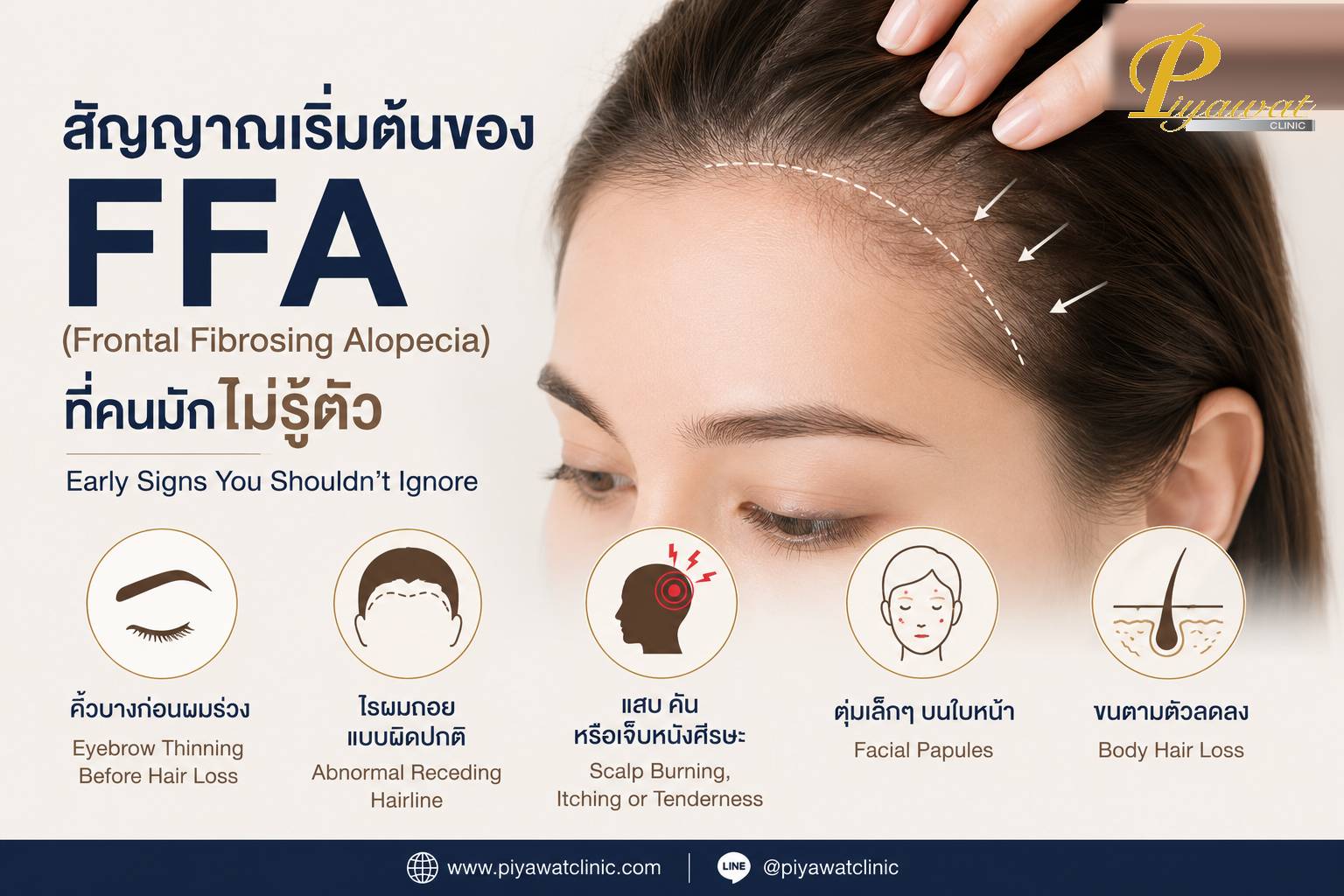
Article by Dr.Piyawat POOMSUWAN
Summary Box
- Frontal Fibrosing Alopecia (FFA) is a form of scarring alopecia that can permanently destroy hair follicles.
- Many patients develop symptoms months or years before obvious hair loss appears.
- Eyebrow thinning is one of the most common early signs and may occur before scalp hair loss.
- Other warning signs include a receding frontal hairline, scalp burning or itching, facial papules, and loss of body hair.
- Early diagnosis is important because permanent follicular destruction may occur before significant hair loss becomes visible.
Introduction
Hair loss is commonly associated with aging, hormonal changes, stress, or genetics. However, not all hair loss conditions are the same.
Frontal Fibrosing Alopecia (FFA) is a type of primary cicatricial alopecia (scarring alopecia) in which inflammation targets critical structures within the hair follicle, eventually leading to permanent follicular destruction and irreversible hair loss.
One of the greatest challenges in diagnosing FFA is that the earliest symptoms are often subtle and frequently overlooked.
Many patients initially notice:
- Thinning eyebrows
- A gradually widening forehead
- A receding frontal hairline
- Burning or itching of the scalp
- Small facial bumps
- Decreasing body hair
Because these changes often occur gradually, patients may attribute them to normal aging and seek medical attention only after substantial hair loss has already occurred.
Why Early Recognition Matters
Unlike androgenetic alopecia (pattern hair loss), FFA involves inflammatory damage to the hair follicle stem cell region, particularly the hair follicle bulge.
This area contains stem cells that are essential for:
- Hair follicle regeneration
- Hair cycling
- New hair growth
When these stem cells are destroyed, the follicle loses its ability to regenerate.
The result is:
- Fibrosis (scar formation)
- Loss of follicular openings
- Permanent hair loss
For this reason, recognizing early symptoms before extensive scarring develops is critical.
Early Sign #1: Thinning Eyebrows Before Scalp Hair Loss
Perhaps the most characteristic early symptom of FFA is eyebrow loss.
Many patients report:
- Gradual thinning of eyebrow density
- Loss of the outer third of the eyebrows
- Increasing reliance on eyebrow makeup
- Progressive eyebrow recession without an obvious cause
Interestingly, eyebrow involvement may precede scalp hair loss by months or even years.
Several studies have identified eyebrow loss as one of the most common clinical findings in FFA and an important diagnostic clue.
Common Patient Searches
Patients frequently search online for:
- Why are my eyebrows thinning?
- Why am I losing the outer part of my eyebrows?
- Can eyebrow loss be an autoimmune disease?
- Eyebrow thinning in women over 40
These questions often lead to the eventual diagnosis of FFA.
Early Sign #2: An Unusual Receding Hairline
Many individuals first notice that:
- Their forehead appears larger
- Their frontal hairline is moving backward
- Their temples are becoming more recessed
- Their sideburn area is disappearing
Unlike androgenetic alopecia, FFA typically produces a characteristic:
Band-Like Frontal Hairline Recession
This pattern commonly affects:
- Frontal hairline
- Temporal hairline
- Sideburn region
The recession usually progresses slowly, making it difficult to appreciate without comparing old photographs.
Patients often realize the change only after viewing photographs taken several years earlier.
Early Sign #3: Burning, Itching, or Tenderness of the Scalp
Many people assume that hair loss should be painless.
However, patients with FFA may experience:
- Burning sensations
- Scalp itching
- Tenderness
- Tightness around the hairline
- Trichodynia (pain associated with the scalp or hair)
These symptoms may result from active inflammation surrounding the hair follicles.
Importantly, symptoms can occur before visible hair loss develops.
As a result, some patients report:
“My scalp feels abnormal, but my hair still looks normal.”
This period may represent an important opportunity for early diagnosis.
Early Sign #4: Facial Papules
One of the lesser-known manifestations of FFA is the development of:
Facial Papules
These appear as small skin-colored bumps on the:
- Forehead
- Temples
- Cheeks
Facial papules are believed to result from inflammation involving facial vellus hair follicles.
Patients frequently mistake them for:
- Acne
- Closed comedones
- Cosmetic irritation
- Allergic reactions
Because they are rarely associated with hair loss in the public mind, facial papules are often overlooked as a potential clue to FFA.
Several studies have reported that facial papules may be associated with more extensive disease involvement.
Early Sign #5: Loss of Body Hair
FFA is increasingly recognized as a condition that affects more than just the scalp.
Patients may notice:
- Reduced underarm hair
- Loss of leg hair
- Thinning arm hair
- Decreased body hair density
These changes often develop gradually and may be attributed to aging.
However, body hair loss may represent another important sign that inflammation is affecting hair follicles throughout the body.
Who Should Consider Evaluation for FFA?
You should consider medical evaluation if you experience:
✓ Thinning eyebrows
✓ Progressive frontal hairline recession
✓ Burning, itching, or tenderness of the scalp
✓ Facial papules
✓ Loss of body hair
✓ A family history of scarring alopecia
These signs are particularly important in middle-aged and postmenopausal women, although FFA may also occur in younger women and men.
Why Is FFA Frequently Diagnosed Late?
The early manifestations of FFA often appear harmless.
Many patients assume their symptoms are related to:
- Aging
- Menopause
- Cosmetic practices
- Stress
- Genetics
Meanwhile, microscopic inflammation may continue silently beneath the skin.
By the time significant hair loss becomes obvious, permanent follicular destruction may already have occurred.
This delay in recognition remains one of the greatest challenges in managing FFA.
How Is FFA Diagnosed?
Diagnosis typically involves:
Clinical Examination
Assessment of hairline recession, eyebrow involvement, facial papules, and body hair loss.
Trichoscopy
A non-invasive examination of the scalp using magnification.
Characteristic findings may include:
- Perifollicular erythema
- Perifollicular scaling
- Absence of follicular openings
- Lonely hair sign
Scalp Biopsy
In selected cases, a biopsy may be performed to confirm the diagnosis and differentiate FFA from other forms of alopecia.
Conclusion
Frontal Fibrosing Alopecia (FFA) often begins with subtle symptoms that many people overlook.
These may include:
- Thinning eyebrows before scalp hair loss
- An unusual receding hairline
- Burning or itching of the scalp
- Facial papules
- Loss of body hair
Because permanent follicular destruction can occur before extensive hair loss becomes visible, early recognition and diagnosis are essential.
Understanding these early warning signs may help patients seek evaluation sooner and improve opportunities for disease stabilization before irreversible scarring develops.
Frequently Asked Questions (FAQ)
Can eyebrow thinning be the first sign of FFA?
Yes. In many patients, eyebrow loss occurs before noticeable scalp hair loss and may be the earliest sign of disease.
Is FFA the same as female pattern hair loss?
No. Female pattern hair loss is primarily a non-scarring form of alopecia, whereas FFA is a scarring alopecia that can permanently destroy hair follicles.
Does FFA cause scalp symptoms?
Yes. Some patients experience burning, itching, tenderness, or scalp discomfort due to follicular inflammation.
Can FFA affect body hair?
Yes. Loss of leg hair, arm hair, and underarm hair may occur in some patients.
Is early diagnosis important?
Absolutely. Once fibrosis and permanent follicular destruction develop, hair regrowth becomes extremely difficult or impossible.
References
- Kossard S. Postmenopausal frontal fibrosing alopecia: scarring alopecia in a pattern distribution. Arch Dermatol. 1994;130:770–774.
- Alenezi S, Ezzat RZ, Miteva M. Frontal fibrosing alopecia part I – Diagnosis and clinical presentation. J Am Acad Dermatol. 2026;94:1059–1072.
- Ezzat RZ, Alenezi S, Miteva M. Frontal fibrosing alopecia part II: Etiopathogenesis and management. J Am Acad Dermatol. 2026;94:1075–1085.
- Porriño-Bustamante ML, Fernández-Pugnaire MA, Arias-Santiago S. Frontal Fibrosing Alopecia: A Review. J Clin Med. 2021;10(9):1805.
- Kępińska K, Jałowska M, Bowszyc-Dmochowska M. Frontal Fibrosing Alopecia – A Review and Practical Guide for Clinicians. Ann Agric Environ Med. 2022;29(2):169–184.
- MacDonald A, Clark C, Holmes S. Frontal Fibrosing Alopecia: A Review of 60 Cases. J Am Acad Dermatol. 2012;67(5):955–961.
- Photiou L, Nixon RL, Tam M, Green J, Yip L. An Update of the Pathogenesis of Frontal Fibrosing Alopecia: What Does the Current Evidence Tell Us? Australas J Dermatol. 2019;60(2):99–104.
- Doche I, Wilcox GL, Ericson M, Valente NS, Romiti R, McAdams BD, Hordinsky MK. Evidence for Neurogenic Inflammation in Lichen Planopilaris and Frontal Fibrosing Alopecia Pathogenic Mechanism. Exp Dermatol. 2020;29(3):282–285.
- Vañó-Galván S, Molina-Ruiz AM, Serrano-Falcón C, et al. Frontal Fibrosing Alopecia: A Multicenter Review of 355 Patients. J Am Acad Dermatol. 2014;70(4):670–678.
- Moreno-Arrones OM, Saceda-Corralo D, Rodrigues-Barata R, et al. Risk Factors Associated with Frontal Fibrosing Alopecia: A Multicentre Case-Control Study. Clin Exp Dermatol. 2019;44(4):404–410.