Article by Dr. Piyawat POOMSUWAN



The Secret Beneath Your Scalp You Never Knew: When “Thinning Hair” in Women Isn’t Just Hormones, but “Inflammation and Fibrosis”
When we talk about Female Pattern Hair Loss (FPHL), we often picture mothers or grandmothers whose hair thins with age. We tend to blame hormones or genetics and simply accept it. However, data from recent research has completely shifted the perspective on treating this condition.
Today, I’m going to digest a deep-dive research paper (a Cross-sectional Observational Study) involving 90 female patients to help you understand why “waiting” is your hair’s worst enemy.
🔍 Looking for Truth through the Lens (Trichoscopy)
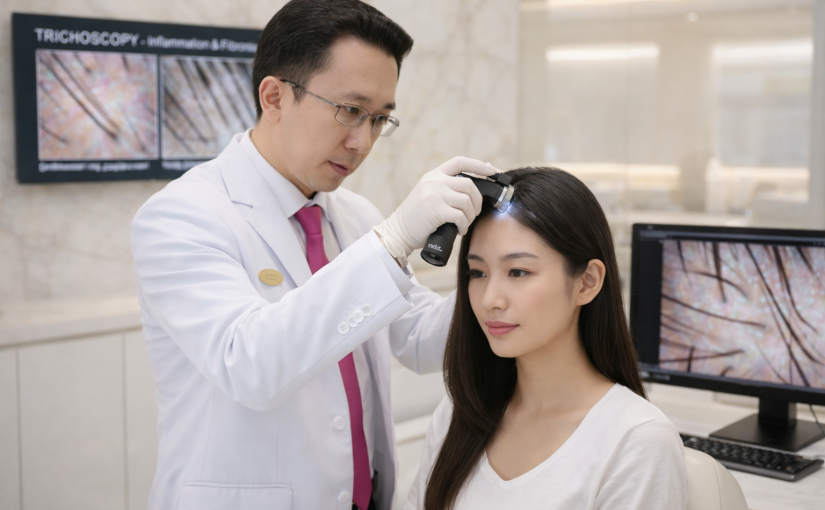
In the past, we might have just looked with the naked eye to make a diagnosis. But today, we have “Trichoscopy”—a dermoscope for the scalp—which acts like a “detective’s magnifying glass.” This research confirms that what we cannot see with the naked eye, but the camera can reveal, is the key:
- 🚩 Anisotrichosis (Variable Hair Diameter): A mix of thick and thin hairs. This is the earliest warning sign that your hair roots are becoming weak.
- 🚩 Dartboard Sign: Concentric rings of different colors around the hair follicle, indicating the severity of the disease.
🔥 The Silent Danger: Inflammation
Shockingly, biopsy results from this research found that over 73% of patients had inflammation hidden beneath the skin. When viewed through the scope, we see this as a “Brown Peripilar Sign” around the follicle.
This is the “Golden Period.” Inflammation means the hair root is currently under attack. If we treat it during this stage—using topical meds, oral medication, medicated shampoos, or treatments to reduce inflammation—we can stop the damage in time.
🚨 The Scary Turning Point: Fibrosis
If inflammation is left untreated for a long time, or treated incorrectly, the consequence is the “White Peripilar Sign”. The research clearly indicates this is associated with the duration of the condition. When a biopsy is performed, “Perifollicular fibrosis” (scarring around the hair root) is found.
Simply put, the living hair root is replaced by scar tissue, making it impossible for new hair to grow, or causing the hair to become so thin it is barely visible. The research found that nearly 1 in 3 patients with severe thinning already had this fibrosis. This has led doctors to view Female Pattern Hair Loss as a condition that can actually become “Micro-cicatricial alopecia” (tiny scarring hair loss).
💡 Conclusion and Self-Care
What I want to leave you with from this research data is:
- ✅ Don’t wait until friends comment: 90% of patients in this research came to see the doctor when their symptoms were already severe (Severity score ≥10), which is difficult to reverse.
- ✅ Observe yourself: If your hair part widens by more than 1 cm or the hair at the front becomes thinner, consult a doctor immediately.
- ♦️ Treatment must be targeted: If inflammation is detected, the doctor may need to prescribe medication or perform treatments to reduce inflammation as well, not just prescribe hair growth stimulants alone, to prevent future fibrosis.
♥️ Thinning hair is treatable, but “Time” is the most critical factor. ♥️
“At Piyawat Clinic, we realize that ‘Precision’ is the heart of treatment and prevention to stop thinning hair from becoming a permanent problem. We have established a standard to analyze scalp conditions using high-magnification cameras (Trichoscopy) for ‘every’ patient and ‘every time’ they come for a consultation or treatment. Because we believe that seeing microscopic signs of abnormality—whether it’s slightly shrinking hair diameter or hidden traces of inflammation—allows us to plan targeted treatments and stop the problem in time. If you want confidence and care that pays attention to every detail for long-term hair health, stop by for a consultation and treatment plan at Piyawat Clinic.”
📚 References
Singh S, Makhecha MB, Rambhia KD. A cross-sectional observational study to correlate the trichoscopic findings of female pattern hair loss with the disease severity and underlying histopathological changes. International Journal of Trichology. 2023;15:221-230.